#include <client.h>
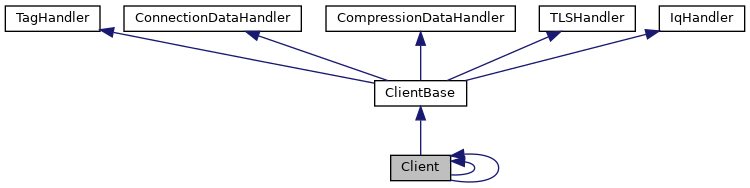
Public Member Functions | |
| Client (const std::string &server) | |
| Client (const JID &jid, const std::string &password, int port=-1) | |
| virtual | ~Client () |
| bool | bindResource (const std::string &resource) |
| bool | selectResource (const std::string &resource) |
| bool | hasResourceBind () const |
| bool | unbindResource (const std::string &resource) |
| const std::string & | resource () const |
| void | setStreamManagement (bool enable=true, bool resume=true) |
| void | ackStreamManagement () |
| void | reqStreamManagement () |
| int | priority () const |
| void | setUsername (const std::string &username) |
| void | setResource (const std::string &resource) |
| void | setPresence (const JID &to, Presence::PresenceType pres, int priority, const std::string &status=EmptyString) |
| void | setPresence (Presence::PresenceType pres, int priority, const std::string &status=EmptyString) |
| void | setPresence () |
| void | setActive () |
| void | setInactive () |
| bool | hasClientStateIndication () const |
| Presence & | presence () |
| GLOOX_DEPRECATED void | setForceNonSasl (bool force=true) |
| void | disableRoster () |
| RosterManager * | rosterManager () |
| void | disconnect () |
| bool | login () |
 Public Member Functions inherited from ClientBase Public Member Functions inherited from ClientBase | |
| ClientBase (const std::string &ns, const std::string &server, int port=-1) | |
| ClientBase (const std::string &ns, const std::string &password, const std::string &server, int port=-1) | |
| virtual | ~ClientBase () |
| bool | connect (bool block=true) |
| virtual ConnectionError | recv (int timeout=-1) |
| virtual const std::string & | username () const |
| const JID & | jid () |
| void | setSasl (bool sasl) |
| void | setTls (TLSPolicy tls) |
| void | setCompression (bool compression) |
| void | setPort (int port) |
| void | setServer (const std::string &server) |
| void | setPassword (const std::string &password) |
| const std::string & | server () const |
| bool | sasl () const |
| TLSPolicy | tls () const |
| bool | compression () const |
| int | port () const |
| virtual const std::string & | password () const |
| virtual Disco * | disco () const |
| const std::string | getID () |
| void | send (Tag *tag) |
| void | send (IQ &iq, IqHandler *ih, int context, bool del=false) |
| void | send (const IQ &iq) |
| void | send (const Message &msg) |
| void | send (const Subscription &sub) |
| void | send (const Presence &pres) |
| bool | authed () const |
| ConnectionState | state () const |
| const std::string & | xmlLang () const |
| void | setXmlLang (const std::string &xmllang) |
| ConnectionBase * | connectionImpl () const |
| void | setConnectionImpl (ConnectionBase *cb) |
| TLSBase * | encryptionImpl () const |
| void | setEncryptionImpl (TLSBase *tb) |
| CompressionBase * | compressionImpl () const |
| void | setCompressionImpl (CompressionBase *cb) |
| void | whitespacePing () |
| void | xmppPing (const JID &to, EventHandler *eh) |
| void | setAuthzid (const JID &authzid) |
| void | setAuthcid (const std::string &authcid) |
| void | setSASLMechanisms (int mechanisms) |
| void | registerStanzaExtension (StanzaExtension *ext) |
| bool | removeStanzaExtension (int ext) |
| void | registerConnectionListener (ConnectionListener *cl) |
| void | registerIqHandler (IqHandler *ih, int exttype) |
| void | removeIDHandler (IqHandler *ih) |
| void | registerMessageHandler (MessageHandler *mh) |
| void | removeMessageHandler (MessageHandler *mh) |
| void | registerMessageSession (MessageSession *session) |
| void | disposeMessageSession (MessageSession *session) |
| void | registerPresenceHandler (PresenceHandler *ph) |
| void | registerPresenceHandler (const JID &jid, PresenceHandler *ph) |
| void | registerSubscriptionHandler (SubscriptionHandler *sh) |
| void | registerTagHandler (TagHandler *th, const std::string &tag, const std::string &xmlns) |
| void | registerStatisticsHandler (StatisticsHandler *sh) |
| void | removeConnectionListener (ConnectionListener *cl) |
| void | removeIqHandler (IqHandler *ih, int exttype) |
| void | removePresenceHandler (PresenceHandler *ph) |
| void | removePresenceHandler (const JID &jid, PresenceHandler *ph) |
| void | removeSubscriptionHandler (SubscriptionHandler *sh) |
| void | removeTagHandler (TagHandler *th, const std::string &tag, const std::string &xmlns) |
| void | removeStatisticsHandler () |
| void | setCACerts (const StringList &cacerts) |
| void | setClientCert (const std::string &clientKey, const std::string &clientCerts) |
| void | registerMessageSessionHandler (MessageSessionHandler *msh, int types=0) |
| LogSink & | logInstance () |
| StreamError | streamError () const |
| const std::string & | streamErrorText (const std::string &lang="default") const |
| const std::string & | streamErrorCData () const |
| const Tag * | streamErrorAppCondition () const |
| AuthenticationError | authError () const |
| StatisticsStruct | getStatistics () |
| void | registerMUCInvitationHandler (MUCInvitationHandler *mih) |
| void | removeMUCInvitationHandler () |
| void | addPresenceExtension (StanzaExtension *se) |
| bool | removePresenceExtension (int type) |
| const StanzaExtensionList & | presenceExtensions () const |
| const TagList | sendQueue () |
| virtual void | handleTag (Tag *tag) |
| virtual void | handleCompressedData (const std::string &data) |
| virtual void | handleDecompressedData (const std::string &data) |
| virtual void | handleReceivedData (const ConnectionBase *connection, const std::string &data) |
| virtual void | handleConnect (const ConnectionBase *connection) |
| virtual void | handleDisconnect (const ConnectionBase *connection, ConnectionError reason) |
| virtual void | handleEncryptedData (const TLSBase *base, const std::string &data) |
| virtual void | handleDecryptedData (const TLSBase *base, const std::string &data) |
| virtual void | handleHandshakeResult (const TLSBase *base, bool success, CertInfo &certinfo) |
| Public Member Functions inherited from TagHandler | |
| virtual | ~TagHandler () |
| Public Member Functions inherited from ConnectionDataHandler | |
| virtual | ~ConnectionDataHandler () |
| Public Member Functions inherited from CompressionDataHandler | |
| virtual | ~CompressionDataHandler () |
| Public Member Functions inherited from TLSHandler | |
| virtual | ~TLSHandler () |
| Public Member Functions inherited from IqHandler | |
| virtual | ~IqHandler () |
Protected Member Functions | |
| void | nonSaslLogin () |
| Protected Member Functions inherited from ClientBase | |
| void | notifyOnResourceBindError (const Error *error) |
| void | notifyOnResourceBind (const std::string &resource) |
| void | notifyOnSessionCreateError (const Error *error) |
| bool | notifyOnTLSConnect (const CertInfo &info) |
| void | notifyOnConnect () |
| void | notifyStreamEvent (StreamEvent event) |
| void | header () |
| void | setAuthed (bool authed) |
| void | setAuthFailure (AuthenticationError e) |
| virtual bool | checkStreamVersion (const std::string &version) |
| void | startSASL (SaslMechanism type) |
| bool | processSASLSuccess (const std::string &payload) |
| void | processSASLChallenge (const std::string &challenge) |
| void | processSASLError (Tag *tag) |
| void | setNTLMDomain (const std::string &domain) |
| void | startTls () |
| bool | hasTls () |
| void | send (const std::string &xml) |
| void | checkQueue (int handled, bool resend) |
| int | stanzasSent () const |
| std::string | getRandom () |
Additional Inherited Members | |
| Protected Types inherited from ClientBase | |
| enum | SMContext { CtxSMInvalid , CtxSMFailed , CtxSMEnable , CtxSMResume , CtxSMEnabled , CtxSMResumed } |
| Protected Attributes inherited from ClientBase | |
| JID | m_jid |
| JID | m_authzid |
| std::string | m_authcid |
| ConnectionBase * | m_connection |
| TLSBase * | m_encryption |
| CompressionBase * | m_compression |
| Disco * | m_disco |
| StanzaExtensionList | m_presenceExtensions |
| GLOOX_DEPRECATED std::string | m_selectedResource |
| std::string | m_clientCerts |
| std::string | m_clientKey |
| std::string | m_namespace |
| std::string | m_password |
| std::string | m_xmllang |
| std::string | m_server |
| std::string | m_sid |
| bool | m_compressionActive |
| bool | m_encryptionActive |
| bool | m_compress |
| bool | m_authed |
| bool | m_resourceBound |
| bool | m_block |
| bool | m_sasl |
| TLSPolicy | m_tls |
| int | m_port |
| int | m_availableSaslMechs |
| SMContext | m_smContext |
| int | m_smHandled |
Detailed Description
This class implements a basic Jabber/XMPP Client.
It supports SASL Authentication as well as TLS (Encryption), which can be switched on/off separately. They are used automatically if the server supports them.
To use, create a new Client instance and feed it connection credentials, either in the Constructor or afterwards using the setters. You should then register packet handlers implementing the corresponding Interfaces (ConnectionListener, PresenceHandler, MessageHandler, IqHandler, SubscriptionHandler), and call connect() to establish the connection to the server.
- Note
- While the MessageHandler interface is still available (and will be in future versions) it is now recommended to use the new MessageSession for any serious messaging.
Simple usage example:
However, you can skip the presence handling stuff if you make use of the RosterManager.
By default, the library handles a few (incoming) IQ namespaces on the application's behalf. These include:
- jabber:iq:roster: by default the server-side roster is fetched and handled. Use rosterManager() and RosterManager to interact with the Roster.
- XEP-0092 (Software Version): If no version is specified, a name of "based on gloox" with gloox's current version is announced.
- XEP-0030 (Service Discovery): All supported/available services are announced. No items are returned.
- Note
- As of gloox 0.9, by default a priority of 0 is sent along with the initial presence.
- As of gloox 0.9, initial presence is automatically sent. Presence: available, Priority: 0. To disable sending of initial Presence use setPresence() with a value of Unavailable prior to connecting.
SASL Authentication
Besides the simple, IQ-based authentication (XEP-0078), gloox supports several SASL (Simple Authentication and Security Layer, RFC 2222) authentication mechanisms.
- DIGEST-MD5: This mechanism is preferred over all other mechanisms if username and password are provided to the Client instance. It is secure even without TLS encryption.
- PLAIN: This mechanism is used if DIGEST-MD5 is not available. It is not secure without encryption.
- ANONYMOUS This mechanism is used if neither username nor password are set. The server generates random, temporary username and resource and may restrict available services.
- EXTERNAL This mechanism is currently only available if client certificate and private key are provided. The server tries to figure out who the client is by external means – for instance, using the provided certificate or even the IP address. (The restriction to certificate/key availability is likely to be lifted in the future.)
Of course, all these mechanisms are not tried unless the server offers them.
Stream Management
To enable Stream Management (XEP-0198), call setStreamManagement() with the first parameter set to true at any time. This will tell the server to enable Stream Management, if the feature is available. Once switched on, Stream Management can not be disabled for a given active stream. However, setting the first parameter to false, it can be disabled inside gloox so that Stream Management will not be used for subsequent connections.
To enable the stream resumption feature, pass true as the second parameter to setStreamManagement(). Upon re-connect after an unexpected (i.e. neither user-triggered nor server-triggered) disconnect, gloox will try to resume the stream and re-send any non-acknowledged stanzas automatically. For stream resumption to work you have to re-connect using the very same Client instance.
After an unexpected disconnect you may check the send queue using sendQueue() . Stanzas in the queue have been sent but not yet acknowledged by the server. Depending on the circumstances of the disconnect, this does not mean that those stanzas have not been received by the recipient.
Constructor & Destructor Documentation
◆ Client() [1/2]
| Client | ( | const std::string & | server | ) |
Constructs a new Client which can be used for account registration only. SASL and TLS are on by default. The port will be determined by looking up SRV records. Alternatively, you can set the port explicitly by calling setPort().
- Parameters
-
server The server to connect to.
Definition at line 103 of file client.cpp.
◆ Client() [2/2]
Constructs a new Client. SASL and TLS are on by default. This should be the default constructor for most use cases. The server address will be taken from the JID. The actual host will be resolved using SRV records. The domain part of the JID is used as a fallback in case no SRV record is found, or you can set the server address separately by calling setServer().
- Parameters
-
jid A full Jabber ID used for connecting to the server. password The password used for authentication. port The port to connect to. The default of -1 means to look up the port via DNS SRV.
Definition at line 115 of file client.cpp.
◆ ~Client()
|
virtual |
Member Function Documentation
◆ ackStreamManagement()
| void ackStreamManagement | ( | ) |
Use this function to send an unrequested 'ack' to the server to let it know the number of handled stanzas. You may use this function at any time. However, gloox will also reply to incoming 'ack requests' automatically. These automatic 'acks' are not announced anywhere in gloox. This function is a no-op if called in situations where sending an ack is not allowed by the protocol.
- Note
- This function is part of XEP-0198.
- Since
- 1.0.4
Definition at line 619 of file client.cpp.
◆ bindResource()
|
inline |
Use this function to bind an additional resource or to re-try to bind a resource in case previous binding failed and you were notified by means of ConnectionListener::onResourceBindError(). Use hasResourceBind() to find out if the server supports binding of multiple resources. bindResource() is a NOOP if it doesn't.
- Note
- ConnectionListener::onResourceBound() and ConnectionListener::onResourceBindError() will be called in case of success and failure, respectively.
- Parameters
-
resource The resource identifier to bind. May be empty. In that case the server will assign a unique resource identifier.
- Returns
- Returns true if binding of multiple resources is supported, false otherwise. A return value of true does not indicate that the resource was successfully bound.
- Note
- It is not necessary to call this function to bind the initial, main, resource.
- Since
- 1.0
◆ disableRoster()
| void disableRoster | ( | ) |
Disables the automatic roster management. You have to keep track of incoming presence yourself if you want to have a roster.
Definition at line 699 of file client.cpp.
◆ disconnect()
| void disconnect | ( | ) |
Disconnects from the server.
Definition at line 739 of file client.cpp.
◆ hasClientStateIndication()
|
inline |
◆ hasResourceBind()
|
inline |
◆ login()
| bool login | ( | ) |
Initiates a login attempt (currently SASL External not supported). This is useful after registering a new account. Simply use setUsername() and setPassword(), and call login().
- Returns
- True if a login attempt could be started, false otherwise. A return value of true does not indicate that login was successful.
Definition at line 453 of file client.cpp.
◆ nonSaslLogin()
|
protected |
Initiates non-SASL login.
Definition at line 706 of file client.cpp.
◆ presence()
|
inline |
◆ priority()
|
inline |
◆ reqStreamManagement()
| void reqStreamManagement | ( | ) |
Use this function to request the number of handled stanzas from the server. You may use this function at any time. gloox does not send any such requests automatically.
- Note
- This function is part of XEP-0198.
- Since
- 1.0.4
Definition at line 629 of file client.cpp.
◆ resource()
|
inline |
◆ rosterManager()
|
inline |
This function gives access to the RosterManager object.
- Returns
- A pointer to the RosterManager.
◆ selectResource()
| bool selectResource | ( | const std::string & | resource | ) |
Use this function to select a resource identifier that has been bound previously by means of bindResource(). It is not necessary to call this function if only one resource is bound. Use hasResourceBind() to find out if the server supports binding of multiple resources.
- Parameters
-
resource A resource string that has been bound previously.
- Note
- If the resource string has not been bound previously, future sending of stanzas will fail.
Definition at line 523 of file client.cpp.
◆ setActive()
|
inline |
Use this function to indicate a client state of 'active' to the Server. See XEP-0352 for more information. This function is a no-op if the server does not support Client State Indication (i.e. nothing is sent). Use hasClientStateIndication() to find out.
- Since
- 1.0.19
◆ setForceNonSasl()
|
inline |
This is a temporary hack to enforce Non-SASL login. You should not need to use it.
- Parameters
-
force Whether to force non-SASL auth. Default true.
- Deprecated:
- Please update the server to properly support SASL instead.
◆ setInactive()
|
inline |
Use this function to indicate a client state of 'inactive' to the Server. See XEP-0352 for more information. This function is a no-op if the server does not support Client State Indication (i.e. nothing is sent). Use hasClientStateIndication() to find out.
- Since
- 1.0.19
◆ setPresence() [1/3]
|
inline |
Use this function to broadcast the entity's presence to all subscribed entities. This is a NOOP if there's no active connection. To send directed presence, use setPresence( const JID&, Presence::PresenceType, int, const std::string& ). If used while a connection already is established a repective presence stanza will be sent out immediately. Use presence() to modify the Presence object.
- Note
- When login is finished, initial presence will be sent automatically. So you do not need to call this function after login.
- Since
- 1.0
◆ setPresence() [2/3]
| void setPresence | ( | const JID & | to, |
| Presence::PresenceType | pres, | ||
| int | priority, | ||
| const std::string & | status = EmptyString |
||
| ) |
Sends directed presence to the given JID. This is a NOOP if there's no active connection. To broadcast presence use setPresence( Presence::PresenceType, int, const std::string& ).
- Parameters
-
to The JID to send directed Presence to. pres The presence to send. priority The priority to include. Legal values: -128 <= priority <= 127 status The optional status message to include.
- Note
- This function does not include any presence extensions (as added by means of addPresenceExtension()) to the stanza.
Definition at line 684 of file client.cpp.
◆ setPresence() [3/3]
| void setPresence | ( | Presence::PresenceType | pres, |
| int | priority, | ||
| const std::string & | status = EmptyString |
||
| ) |
Use this function to set the entity's presence, that is, to broadcast presence to all subscribed entities. To send directed presence, use setPresence( const JID&, Presence::PresenceType, int, const std::string& ). If used prior to establishing a connection, the set values will be sent with the initial presence stanza. If used while a connection already is established, a presence stanza will be sent out immediately.
- Parameters
-
pres The Presence value to set. priority An optional priority value. Legal values: -128 <= priority <= 127 status An optional message describing the presence state.
- Since
- 0.9
Definition at line 674 of file client.cpp.
◆ setResource()
|
inline |
◆ setStreamManagement()
| void setStreamManagement | ( | bool | enable = true, |
| bool | resume = true |
||
| ) |
This function enables Stream Management (XEP-0198) if the server supports it. Optionally, stream resumption can be disabled.
- Note
- You can use this function at any time. However, gloox will make sure Stream Management requests are sent only when allowed by the specification.
- Parameters
-
enable Enable or disable Stream Management. Note: once enabled on a connection, Stream Management can not be disabled for that connection. resume Tells the server whether to enable stream resumption. Defaults to true.
- Note
- This function is part of XEP-0198.
- Since
- 1.0.4
Definition at line 570 of file client.cpp.
◆ setUsername()
| void setUsername | ( | const std::string & | username | ) |
Sets the username to use to connect to the XMPP server.
- Parameters
-
username The username to authenticate with.
Definition at line 143 of file client.cpp.
◆ unbindResource()
|
inline |
Use this function to unbind a resource identifier that has been bound previously by means of bindResource(). Use hasResourceBind() to find out if the server supports binding of multiple resources. unbindResource() is a NOOP if it doesn't.
- Parameters
-
resource A resource string that has been bound previously.
- Note
- Servers are encouraged to terminate the connection should the only bound resource be unbound.
The documentation for this class was generated from the following files: