#include <messagesession.h>
Public Member Functions | |
| MessageSession (ClientBase *parent, const JID &jid, bool wantUpgrade=true, int types=0, bool honorTID=true) | |
| virtual | ~MessageSession () |
| const JID & | target () const |
| const std::string & | threadID () const |
| void | setThreadID (const std::string &thread) |
| bool | honorThreadID () const |
| void | registerMessageHandler (MessageHandler *mh) |
| void | removeMessageHandler () |
| virtual void | send (const std::string &message, const std::string &subject=EmptyString, const StanzaExtensionList &sel=StanzaExtensionList()) |
| void | registerMessageFilter (MessageFilter *mf) |
| void | removeMessageFilter (MessageFilter *mf) |
| void | disposeMessageFilter (MessageFilter *mf) |
| int | types () const |
| void | resetResource () |
| virtual void | handleMessage (Message &msg) |
Protected Member Functions | |
| virtual void | send (const Message &msg) |
Detailed Description
An abstraction of a message session between any two entities.
This is an alternative interface to unmanaged messaging. The original interface, using the simple MessageHandler-derived interface, is based on an all-or-nothing approach. Once registered with ClientBase, a handler receives all message stanzas sent to this client and has to do any filtering on its own.
MessageSession adds an abstraction to a chat conversation. A MessageSession is responsible for communicating with exactly one (full) JID. It is extensible with so-called MessageFilters, which can provide additional features such as Message Events, or Chat State Notifications.
You can still use the old MessageHandler in parallel, but messages will not be relayed to both the generic MessageHandler and a MessageSession established for the sender's JID. The MessageSession takes precedence.
Using MessageSessions has the following advantages over the plain old MessageHandler:
- automatic creation of MessageSessions
- filtering by JID
- automatic handling of threading (i.e., XMPP message threads)
- simpler sending of messages
- support for MessageFilters.
Usage:
Derive an object from MessageSessionHandler and reimplement handleMessageSession() to store your shiny new sessions somewhere, or to create a new chat window, or whatever. Register your object with a ClientBase instance using registerMessageSessionHandler(). In code:
MyClass is a MessageSessionHandler here.
In this example, MyClass needs to be MessageHandler, MessageEventHandler and ChatStateHandler, too. The handlers are registered with the session to receive the respective events.
MessageEventHandler::handleMessageEvent() and ChatStateHandler::handleChatState() are called for incoming Message Events and Chat States, respectively.
To let the chat partner now that the user is typing a message or has closed the chat window, use raiseMessageEvent() and setChatState(), respectively. For example:
To send a message to the chat partner of the session, use send( const std::string& message, const std::string& subject, const StanzaExtensionList& ). You don't have to care about receipient, thread id, etc., they are added automatically.
To initiate a new chat session, all you have to do is create a new MessageSession and register a MessageHandler with it:
- Note
- You should never delete a MessageSession manually. Use ClientBase::disposeMessageSession() instead.
- Since
- 0.8
Definition at line 145 of file messagesession.h.
Constructor & Destructor Documentation
| MessageSession | ( | ClientBase * | parent, |
| const JID & | jid, | ||
| bool | wantUpgrade = true, |
||
| int | types = 0, |
||
| bool | honorTID = true |
||
| ) |
Constructs a new MessageSession for the given JID. It is recommended to supply a full JID, in other words, it should have a resource set. No resource can lead to unexpected behavior. A thread ID is generated and sent along with every message sent through this session.
- Parameters
-
parent The ClientBase to use for communication. jid The remote contact's full JID. If you don't know the full JID (this is probably the most common case) but still want replies from the full JID to be handled by this MessageSession, set the wantUpgrade parameter to true (or leave it untouched). wantUpgrade This flag indicates whether gloox should try to match an incoming message from a full JID to this MessageSession. If unsure, use the default. You probably only want to use a non-default value if this MessageSession is supposed to talk directly to a server or component JID that has no resource. This 'upgrade' will only happen once. types ORed list of Message::MessageType values this MessageSession shall receive. Defaults to 0 which means any type is received. honorTID Indicates whether thread IDs should be honored when matching incoming messages to MessageSessions. The default is usually fine.
Definition at line 24 of file messagesession.cpp.
|
virtual |
Virtual destructor.
- Note
- You should never delete a MessageSession manually. Use ClientBase::disposeMessageSession() instead.
Definition at line 32 of file messagesession.cpp.
Member Function Documentation
| void disposeMessageFilter | ( | MessageFilter * | mf | ) |
Use this function to remove and delete a MessageFilter from the MessageSession.
- Parameters
-
mf The MessageFilter to remove and delete.
- Note
- To just remove (and not delete) the MessageFilter use removeMessageFilter().
Definition at line 105 of file messagesession.cpp.
|
virtual |
This function can be used to feed a message into the session. Ususally, only ClientBase should call this function.
- Parameters
-
msg A Message to feed into the session.
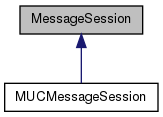
Reimplemented in MUCMessageSession.
Definition at line 37 of file messagesession.cpp.
|
inline |
Indicates whether thread IDs are honored when matching incoming messages to MessageSessions.
- Returns
- Whether thread IDs are honored.
Definition at line 203 of file messagesession.h.
|
inline |
Use this function to hook a new MessageFilter into a MessageSession. The filter will be able to read and/or modify a message stanza's content.
- Note
- The MessageSession will become the owner of the filter, it will be deleted by MessageSession's destructor. To get rid of the filter before that, use disposeMessageFilter().
- Parameters
-
mf The MessageFilter to add.
Definition at line 240 of file messagesession.h.
|
inline |
Use this function to associate a MessageHandler with this MessageSession. The MessageHandler will receive all messages sent from this MessageSession's remote contact.
- Parameters
-
mh The MessageHandler to register.
Definition at line 211 of file messagesession.h.
|
inline |
Use this function to remove a MessageFilter from the MessageSession.
- Parameters
-
mf The MessageFilter to remove.
- Note
- To remove and delete the MessageFilter in one step use disposeMessageFilter().
Definition at line 248 of file messagesession.h.
|
inline |
This function clears the internal pointer to the MessageHandler and therefore disables message delivery.
Definition at line 218 of file messagesession.h.
| void resetResource | ( | ) |
This function resets the session's target JID to its bare form such that subsequently sent messages will be sent to that bare JID. The server will determine the best resource to deliver to. Useful if the target resource changed presence to e.g. away or offline.
Definition at line 94 of file messagesession.cpp.
|
virtual |
A convenience function to quickly send a message (optionally with subject). This is the preferred way to send a message from a MessageSession.
- Parameters
-
message The message to send. subject The optional subject to send. sel An optional list of StanzaExtensions. The extensions will be owned by the message-to-be-sent; do not attempt to re-use or delete them.
Definition at line 62 of file messagesession.cpp.
|
protectedvirtual |
A wrapper around ClientBase::send(). You should not use this function to send a chat message because the Tag is not prepared accordingly (neither a thread ID is added nor is the message ran through the message filters).
- Parameters
-
msg A Message to send.
Definition at line 84 of file messagesession.cpp.
|
inline |
Use this function to set the session's thread ID if e.g. a specific thread is continued. It should not normally be needed to set the thread ID manually.
- Parameters
-
thread The new thread ID.
Definition at line 196 of file messagesession.h.
|
inline |
Use this function to find out where this session points at.
- Returns
- The receipient's JID.
Definition at line 182 of file messagesession.h.
|
inline |
By default, a thread ID is sent with every message to identify messages belonging together.
- Returns
- The thread ID for this session.
Definition at line 189 of file messagesession.h.
|
inline |
Returns the message type this MessageSession wants to receive.
- Returns
- ORed list of Message::MessageType values this MessageSession wants to receive.
Definition at line 262 of file messagesession.h.
The documentation for this class was generated from the following files: