#include <mucroom.h>
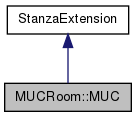
Public Member Functions | |
| MUC (const std::string &password, HistoryRequestType historyType=HistoryUnknown, const std::string &historySince=EmptyString, int historyValue=0) | |
| MUC (const Tag *tag=0) | |
| virtual | ~MUC () |
| const std::string * | password () const |
| const std::string * | historySince () const |
| virtual const std::string & | filterString () const |
| virtual StanzaExtension * | newInstance (const Tag *tag) const |
| virtual Tag * | tag () const |
| virtual StanzaExtension * | clone () const |
 Public Member Functions inherited from StanzaExtension Public Member Functions inherited from StanzaExtension | |
| StanzaExtension (int type) | |
| virtual | ~StanzaExtension () |
| int | extensionType () const |
Detailed Description
Constructor & Destructor Documentation
| MUC | ( | const std::string & | password, |
| MUCRoom::HistoryRequestType | historyType = HistoryUnknown, |
||
| const std::string & | historySince = EmptyString, |
||
| int | historyValue = 0 |
||
| ) |
Creates a new MUC object.
- Parameters
-
password An optional room password. historyType The type of room history to request. historySince A string describing the amount of room history. historyValue The amount of requested room history.
Definition at line 540 of file mucroom.cpp.
Constructs a new MUCUser object from the given Tag.
- Parameters
-
tag The Tag to parse.
Definition at line 551 of file mucroom.cpp.
|
virtual |
Virtual destructor.
Definition at line 581 of file mucroom.cpp.
Member Function Documentation
|
inlinevirtual |
Returns an identical copy of the current StanzaExtension.
- Returns
- An identical copy of the current StanzaExtension.
Implements StanzaExtension.
|
virtual |
Returns an XPath expression that describes a path to child elements of a stanza that an extension handles.
- Returns
- The extension's filter string.
Implements StanzaExtension.
Definition at line 587 of file mucroom.cpp.
|
inline |
|
inlinevirtual |
Returns a new Instance of the derived type. Usually, for a derived class FooExtension, the implementation of this function looks like:
- Returns
- The derived extension's new instance.
Implements StanzaExtension.
|
inline |
|
virtual |
Returns a Tag representation of the extension.
- Returns
- A Tag representation of the extension.
Implements StanzaExtension.
Definition at line 593 of file mucroom.cpp.
The documentation for this class was generated from the following files: